NUMBERS
The bottom line on legal and illegal immigration is
the numbers.
Even though the 2010 Census Bureau estimates a 10-12
million illegal alien population, it is commonly
known that many aliens avoid the census count and it
is widely believed that as many as 20 million illegal
aliens are illegally present in the U.S. as of
2005.
The charts below describe legal immigration, but it
is important to recognize that illegal immigration
rises as legal immigration rises.
HISTORICAL LEVELS OF IMMIGRATION INTO THE
U.S.

U.S. POPULATION GROWTH CAUSED BY IMMIGRATION INTO THE
U.S.
Advocating U.S. population stabilization necessitates
a reduction in immigration levels. It is
virtually mathematically impossible to be for U.S.
population stabilization and against immigration
reduction.
The focus on population limits has waned since the
70's even though the U.S. is now the world's third
largest country and the world's fastest growing
industrialized nation. It is pertinent that Americans
understand the true source of growth and be able to
link the symptoms to the source.
The chart below shows the U.S. Census Bureau's
middle-range projection of how much additional
population will be forced into the United States if
current immigration and fertility levels
continue.
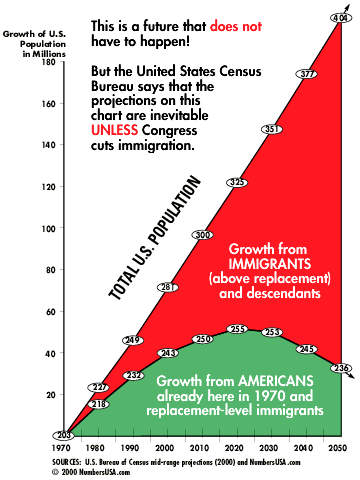
The RED BLOCK shows the phenomenal population growth
being fueled by the federal government's immigration
policies. The red represents all the immigrants
(above the replacement level of 222,000) who have
arrived -- or are projected to arrive -- since 1970,
plus their descendants, minus deaths.
The GREEN BLOCK represents U.S. population growth due
to the descendants of 1970-stock Americans. It
assumes that these "old-stock" Americans
will continue their present fertility and mortality
rates. There were 203 million people living in the
U.S. in 1970. Births to that population have exceeded
their deaths, resulting in the growth illustrated in
the green block. But the below-replacement-level
fertility of "old-stock" Americans will
allow this group to stabilize in size soon after the
Baby Boomers' children finish having babies. (The
Green Block also accounts for replacement-level
immigration, which the Census Bureau currently
estimates at 222,000 a year.)
Without the radical increase in the numbers of
immigrants coming to the United States since 1970,
U.S. population would almost be stabilized by now and
would peak in 2020 at 255 million (52 million higher
than in 1970).
The TOP LINE of the chart represents the actual U.S.
population growth between 1970 and now, and is a
projection of what the growth will be between now and
the year 2050 if fertility, mortality and immigration
rates remain similar to those of today. The
additional 200 million people contribute to almost
doubling the U.S. population of 1970 -- a time when
most Americans believed the country already had
enough congestion and sprawl.
Of the 120 million people who will be added to the
United States over the next 5 decades, 100% are
represented in the RED BLOCK on the chart above.
To find similar population growth in foreign
countries, we must look to the Third World.
Nearly every other advanced country in the world is
moving quickly toward a stabilized population -- or
already has achieved it. But Congress each year
endorses immigration numbers that force the United
States to deal with many of the same problems of
rampant population growth that plague the world's
poorest countries.
|